

Plasma Cleaning for Molding
Delamination and voiding under the mold compound usually start with a lead frame surface the compound never keyed into. Plasma cleaning fixes that before the press does its job.
When a transfer-molded package starts showing delamination or voiding under the mold compound — cracks at the compound-to-frame interface, moisture ingress after temperature cycling, popcorn-type failures during reflow — the first instinct is to look at the mold compound itself: cure profile, filler content, transfer pressure. Those variables matter, but in a large share of persistent cases the compound was never the problem. The lead frame or substrate surface it was asked to bond to was.
Why mold compound delaminates from the lead frame
Delamination isn't usually a sign that two materials are chemically incompatible. More often, both materials were selected correctly and would bond well together — but the interface between them never got the chance, because the frame arrived at the mold press carrying oxide film, organic residue, or handling oils. That contamination sits as a barrier between the mold compound and the frame, so the bond that forms across it is weaker than the process was designed to deliver. And because the failure is a weak bond rather than an absent one, it frequently doesn't show up as a rejected part at the press — it shows up later, during thermal cycling, vibration, or moisture exposure, once the interface is finally put under enough stress to separate.
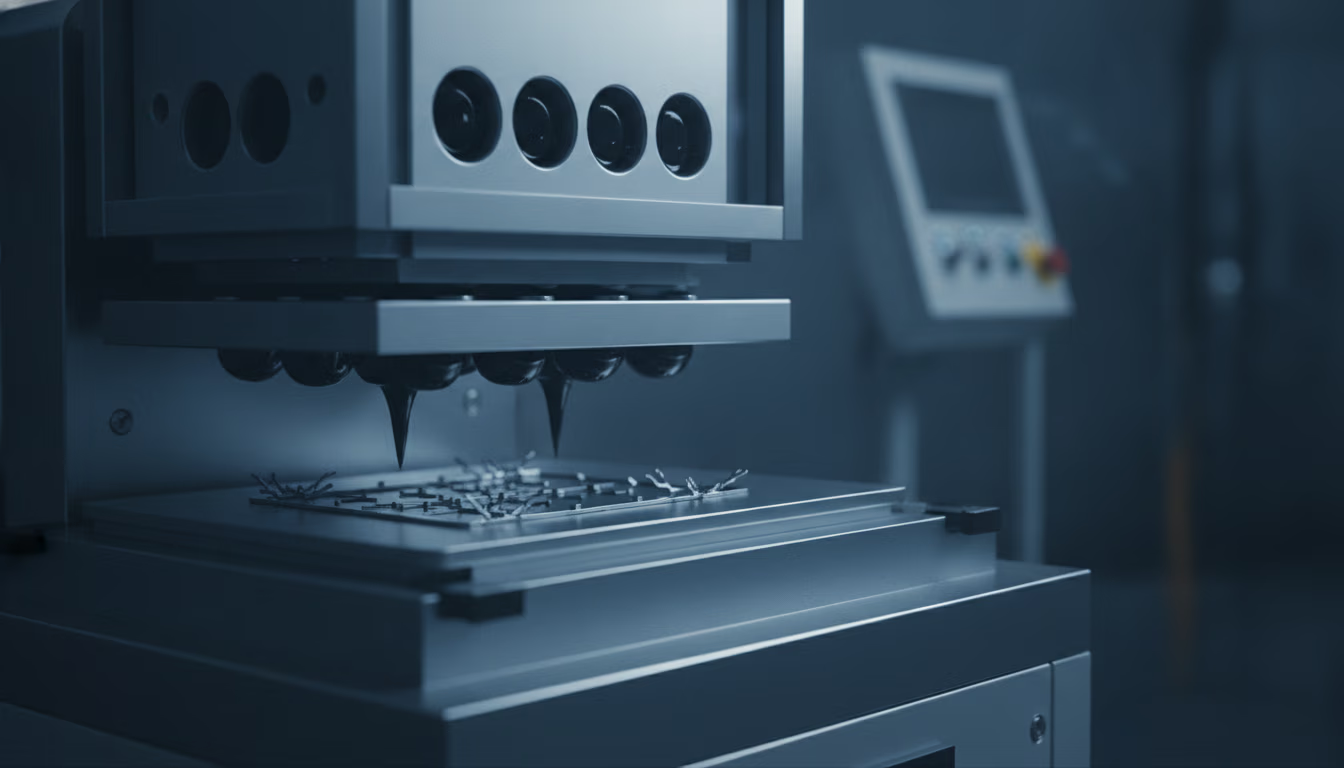
How plasma cleaning creates a bondable surface before the press
Vacuum plasma cleaning addresses the interface directly, before the frame reaches the mold tool, rather than trying to compensate for a bad bond after the fact. The process has two effects working together: it removes the oxide and organic layers that block adhesion, and it activates the surface — raising its energy so the mold compound wets and keys into it instead of resisting it. Gas chemistry determines which effect dominates: argon is the standard choice for stripping contamination, while oxygen or nitrogen can be used to functionalise the surface further where the compound needs additional chemical compatibility with the substrate. Applied ahead of transfer molding and overmolding, this surface preparation is what allows a properly matched compound and frame to hold together under thermal stress and high-moisture environments instead of separating months into the field.
Where plasma cleaning sits in the process
Plasma cleaning is introduced as a pre-treatment step immediately before the frame or substrate is loaded into the mold tool, and the right system depends on part format and line volume:
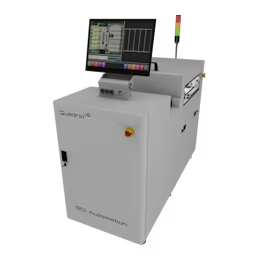
- Quadrio Alpha — a magazine-fed system built for lead frames: each frame is pulled from its magazine, plasma-treated, and returned to the same magazine, with the Alpha 4 running up to four magazines concurrently and the Alpha 5 up to five, plus per-frame traceability for MES integration. It's the standard choice ahead of transfer molding on lead-frame packages.
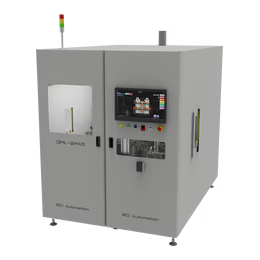
- QML-2MAG — an automated batch system for lead frames in magazines: two independent plasma chambers treat whole magazines with no per-frame handling, and SMEMA compatibility integrates it into an automated line ahead of the mold tool.
- JUNO-M — a batch system for lead frames in magazines, with or without side slots: four magazines are plasma-treated in pre-defined positions in a stainless steel chamber, ISO5 cleanroom compatible as standard, ahead of the mold tool.
- QML-CI — an inline system with a conveyor-indexer that loads and unloads the chamber in a single motion, built for 24/7 continuous production on module and PCB/BGA lines feeding a transfer-molding step.
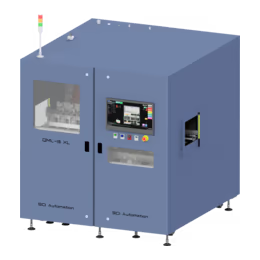
- QML-B XL — a heavy duty inline system whose 44.4 L chamber takes big trays and module assemblies up to 533 x 280 x 180 mm, SMEMA-connected ahead of the mold tool so parts move from plasma to molding with no manual handling.
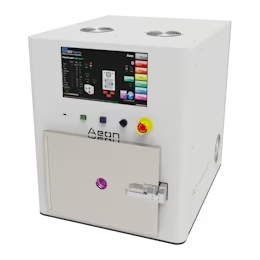
- Aeon — a table-top batch system for lab qualification and lower-volume production, covering the same wire-bonding, transfer-molding and PCB/BGA prep applications as the inline systems without a full production-line footprint.
Whichever configuration fits the line, the plasma step treats every frame to the same standard, so the mold compound is bonding to a surface that's been prepared, not to whatever contamination happened to survive the upstream handling steps.

Verifying the mold interface
Delamination is often invisible until a part is destructive-tested or put under stress, so verification has to happen at two points. Before molding, a contact-angle check on a sample of treated frames confirms the plasma step raised surface energy the way it's supposed to — a surface that still resists wetting after treatment is a sign of a chamber or recipe problem, not a bad batch of frames. After molding, a break test on sacrificial parts shows whether the bond formed at all: a clean separation into two smooth surfaces means the mold compound never keyed into the frame, while material from one side remaining stuck to the other means the bond is as strong as the base materials. For parts that need to stay intact, acoustic microscopy finds voids and weak bonds non-destructively by reading how sound waves travel through the assembly, catching a delamination risk before it reaches the field.


Related industries
Related articles
Why Your Wire Bonding Is Failing and How to Fix It with Plasma Cleaning
Wire bonding failures don't happen by accident, and blaming machines or operators misses the real problem.

How Plasma Cleaning Solves Delamination Risks in Multi-Material Assemblies
When two materials don't bond properly, failure is often only a matter of time. Delamination—where bonded surfaces separate under stress...
Frequently asked questions
Why does mold compound delaminate from the lead frame even when the compound and cure profile are correct?
Delamination is usually an interface problem, not a material-compatibility problem: oxide film or organic residue on the frame blocks the mold compound from bonding properly, so the interface stays weak even though the compound and frame would bond well on a clean surface.
What does plasma cleaning actually do to the lead frame before molding?
It has two effects: it strips oxide and organic contamination that blocks adhesion, and it activates the surface by raising its energy so the mold compound wets and keys into it. Argon is the standard gas for cleaning; oxygen or nitrogen add further surface functionalisation where needed.
How do you catch delamination if it isn't visible right after molding?
A break test on sacrificial parts shows whether the bond formed — a clean separation means it didn't. For parts that need to stay intact, acoustic microscopy detects internal voids and weak bonds non-destructively using sound waves.
Does plasma cleaning replace the mold compound qualification process?
No — it's a surface pre-treatment step, introduced ahead of the mold tool, that ensures the compound is bonding to a clean, activated surface. Compound selection and cure profile are unaffected.
Which plasma system fits a transfer-molding line?
It depends on part format and volume: Quadrio Alpha for magazine-fed lead frames, QML-2MAG for lead frames treated whole in their magazines on an automated line, JUNO-M for magazines without side slots or ISO5 cleanrooms, QML-CI for inline module and PCB/BGA lines, QML-B XL for big trays and module assemblies inline, and Aeon for lab qualification or lower-volume production.