

Our Plasma Cleaning Equipment
Explore our advanced plasma cleaning solutions, categorised to meet your diverse needs.
Optimise manufacturing with Batch Cleaners, streamline workflows using In-Line Cleaners, achieve precision with Strip/Standalone Cleaners, equip research and teaching labs with Laboratory Systems, remove voids from dispensed epoxy with Vacuum Degassing Systems, or innovate with Custom Solutions tailored for various materials and industries.
Batch Plasma Cleaners
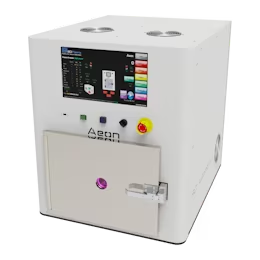
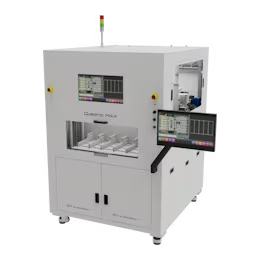
Batch plasma cleaning systems are a type of plasma cleaning system designed to clean multiple parts or components at once. These systems are commonly used in manufacturing settings where large quantities of components need to be cleaned quickly and efficiently or in laboratory environments where quick prototyping is required.
Batch plasma cleaning systems use a vacuum chamber to hold the components during the cleaning process, this allows for products with different dimensions and form factors to be treated without modifications of the plasma machine.
Once the chamber is closed, the process gas is introduced and the plasma is formed. The plasma will interact with the components, removing any unwanted contaminants and leaving the surface clean and active. Batch plasma cleaning systems are versatile and can be used to clean a wide range of materials, including metals, plastics, and ceramics.
In-Line Plasma Cleaners
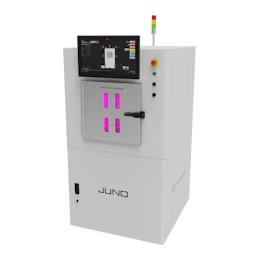
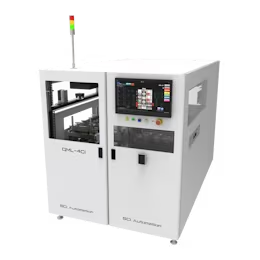
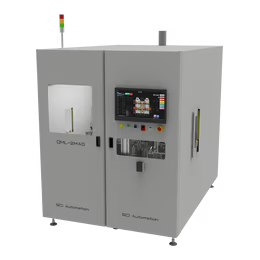
Inline plasma cleaning systems are designed to clean components as they move through the production line. These systems are commonly used in high-volume manufacturing environments where time is a critical factor.
Inline plasma cleaning systems allow for the best performance as the products are introduced automatically in the plasma chamber; after the process is completed, the products are sent immediately to the following production step allowing for the best surface cleaning and activation possible.
When the products are in the plasma chamber, they are exposed to plasma, which removes any unwanted contaminants and activates the surface.
Inline plasma cleaning systems are highly efficient and can clean components in a matter of seconds.
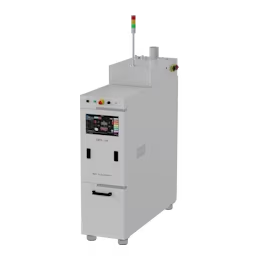
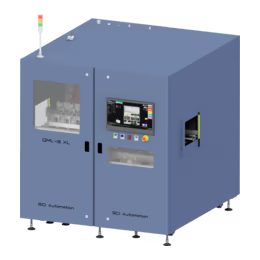
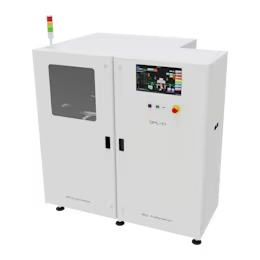
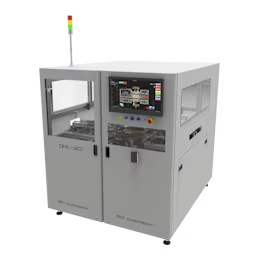
Strip Plasma Cleaners
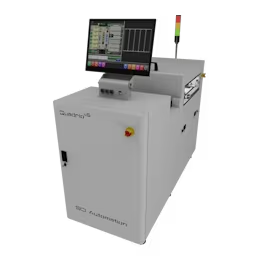
Plasma systems for lead frames in magazines
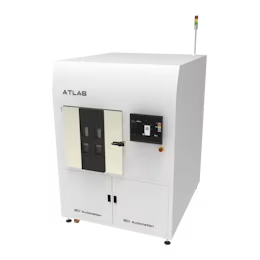
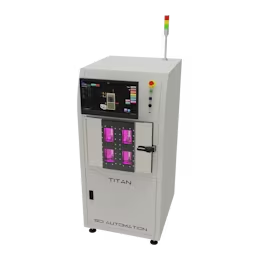
These types of plasma cleaning system are designed to clean and activate products with a flat form factor stored in magazines, typically lead frames used in the semiconductors before the wire-bonding and molding manufacturing processes.
These systems use a vacuum chamber to hold the products during the plasma cleaning process, the process gas is then introduced and formed into a plasma.
The plasma interacts with the surface, removing any unwanted contaminants and leaving a clean and active surface.
Strip plasma cleaning systems typically use a combination of different plasma gases and power levels to achieve the desired level of cleaning. Strip plasma cleaning systems are highly effective and can clean surfaces to extremely high levels of purity, making them ideal for use in industries such as pure semiconductors manufacturing as well as manufacturing of automotive high-value added products.
High-Power Plasma Cleaners
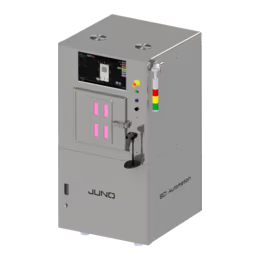
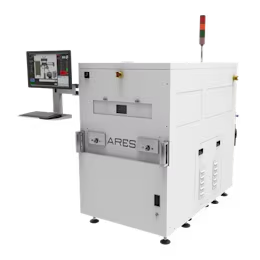
These high-power plasma cleaning systems have been designed to deliver a consistent plasma process when high intensity is required.
These systems a typically used for applications like: oxide layers removal, polymer cross-linking applications or large substrates cleaning.
Laboratory Plasma Cleaners
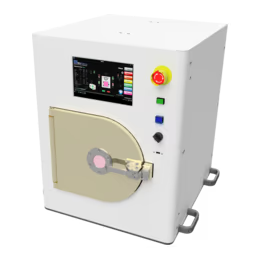
Universities, research groups and R&D laboratories need plasma systems that fit on a bench and within a budget, without compromising on the quality of the results.
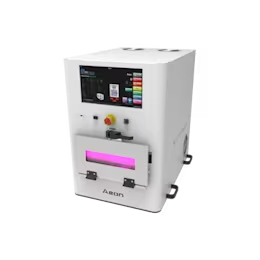
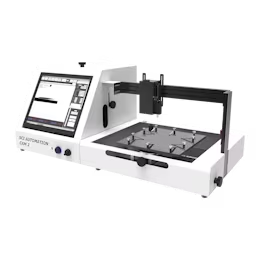
Our laboratory plasma systems share the control platform and safety standards of our production equipment: an industrial Windows PC running the SCI plasma software, multi-step recipes, automatic process logging, SEMI S2/S8 and CE compliance. SCI Mini is the entry point for teaching, research and feasibility studies, AEON adds four shelves and a 13.56 MHz RF generator for higher throughput, and CAM-2 measures the contact angle to verify the result of the treatment.
Instruments
Assessing the effectiveness of a plasma cleaning process is crucial for ensuring proper process validation.
One of the simplest methods involves the measurement of the contact angle value of a drop of water, or other fluid, dispensed on the product surface.
The measurement of the contact angle value directly relates to the surface energy value, measuring before and after the plasma cleaning process allows to easily determine its effectiveness.
Vacuum Degassing Systems
Void-free epoxy, underfill and potting before cure
Epoxy dispensed into a narrow gap, under a component or into a potting cavity traps air on its way in, and every bubble left in the resin cures into a void.
Vacuum degassing systems remove that air before the resin cures. The pressure follows a programmed profile: a controlled descent lets the bubbles expand and escape without pushing the resin out of the gap, a dwell holds the target pressure, and a controlled nitrogen raise brings the parts back to atmosphere.
They sit between the dispenser and the curing oven, and complement plasma treatment: plasma makes the surfaces wettable so the resin flows into the gap, and degassing removes the air it carries with it.
Custom Plasma Cleaners
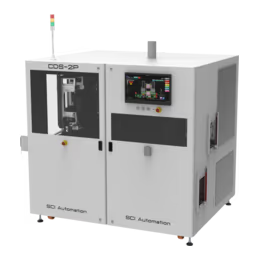
Custom Plasma Cleaning Systems offer tailored solutions for diverse cleaning needs.
Meticulously designed to address unique requirements, these systems provide
precision and innovation across various materials and industries.
Elevate your cleaning strategy with bespoke machines that ensure excellence and flexibility.
Find the right system for your process
Browse the full range, download datasheets, or talk to our engineers about your application.