

Plasma Cleaning for Aerospace Manufacturing
A delaminated composite joint or a paint system that fails on an airframe skin isn't a warranty claim, it's a structural finding. Vacuum plasma treatment removes the oxide and contamination that cause it before assembly.
An aerospace bond, coating or seal doesn't get a second chance in the way a consumer product does — a delaminated CFRP joint, a paint system that fails on an aluminium skin, or a thermal-protection coating that doesn't adhere ahead of re-entry heating is a structural or flight-safety problem, not a warranty claim. Every one of those failure modes traces back to the same starting condition: what was actually sitting on the surface before the bond, coating or seal was applied.
The problem: oxide layers and composite bond lines under structural load
Titanium and aluminium aerospace alloys form oxide layers that block both paint adhesion and structural bonding — and aerospace-grade stock, after machining and storage, can carry oxide thicker than a monolayer, which is why aerospace surface prep often needs to remove oxide in the micrometer range rather than just a surface film. CFRP composite bonding depends on activating the carbon-fibre surface so resin properly wets and bonds to it; an under-activated fibre surface is a delamination risk built into a structural assembly before it's ever loaded. Turbine blades and engine components accumulate manufacturing residues that, left in place, shorten component life and reduce performance.
Some of these failure modes carry consequences beyond the part itself. Satellite and spacecraft components have to be sterilized to cleanroom and planetary-protection standards before launch — a cleaning failure here isn't a quality escape, it's a mission-compliance failure that can put a launch license at risk. Sensitive elements like optical sensors and MEMS gyroscopes and accelerometers need cleaning aggressive enough to remove contamination but gentle enough not to damage the delicate structures that give a navigation system its precision.

Where vacuum plasma treatment fits
Gas selection follows the material and the failure mode being addressed. Argon plasma physically sputters away oxide and inorganic layers without altering the underlying metal chemistry — a controlled way to strip an oxide layer from titanium or aluminium without introducing new surface chemistry to complicate a subsequent bond. Oxygen plasma oxidatively removes organic residues and activates composite fibre surfaces ahead of resin bonding. Hydrogen plasma reduces stubborn metal oxides back to bare, bondable metal where argon sputtering alone isn't enough.
Aerospace-grade oxide layers and composite cure requirements often call for more plasma energy and longer dwell times than general industrial cleaning — thicker titanium oxide, deeper composite fibre activation, or polymer cross-linking processes all need sustained high-power delivery rather than a short standard cycle. At the other end of the same process family, the lower-power, tightly controlled recipes used for optical elements and MEMS devices are tuned specifically to avoid damaging delicate structures while still removing the contamination that would otherwise degrade sensor precision.
Where it sits in the manufacturing and maintenance process
- Pre-paint and pre-coating surface prep — removes oxides and residues from aluminium airframe skin ahead of paint or protective coating, improving adhesion durability under environmental exposure.
- Composite (CFRP) bonding — activates carbon-fibre surfaces ahead of matrix bonding, improving fibre-to-resin adhesion in structural assemblies.
- Structural and thermal-protection bonding — prepares aluminium, titanium and polymer surfaces ahead of adhesive bonding, including thermal-protection coatings that must survive re-entry heating.
- Turbine and engine component cleaning — removes manufacturing residues from turbine blades and engine parts, supporting component lifespan and performance.
- Sterilization and decontamination — cleans satellite and spacecraft components to cleanroom and planetary-protection standards ahead of launch.
- MEMS and sensor cleaning — treats gyroscopes, accelerometers and optical elements without damaging delicate structures, preserving navigation-system precision.
Matching the system to the line
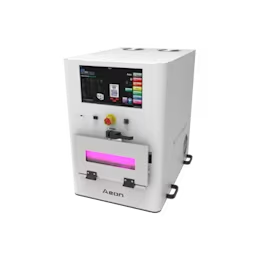
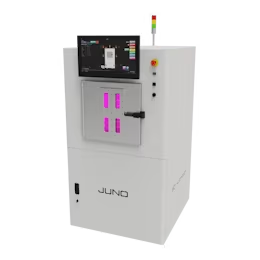
Aeon-HP is a high-power table-top batch system with integrated temperature monitoring and heat dissipation purpose-built for sustained high-power cycles — the energy and dwell time aerospace processes often demand for composite panel activation, polymer cross-linking, and oxide removal at micrometer thickness on titanium and aluminium structures, on lab or lower-volume production batches. Juno is the batch system for bulky or awkwardly shaped aerospace parts: its reconfigurable shelf layout adapts to almost any geometry, so hardware that doesn't share a common footprint is treated together in one chamber rather than one piece at a time.
Verifying the result
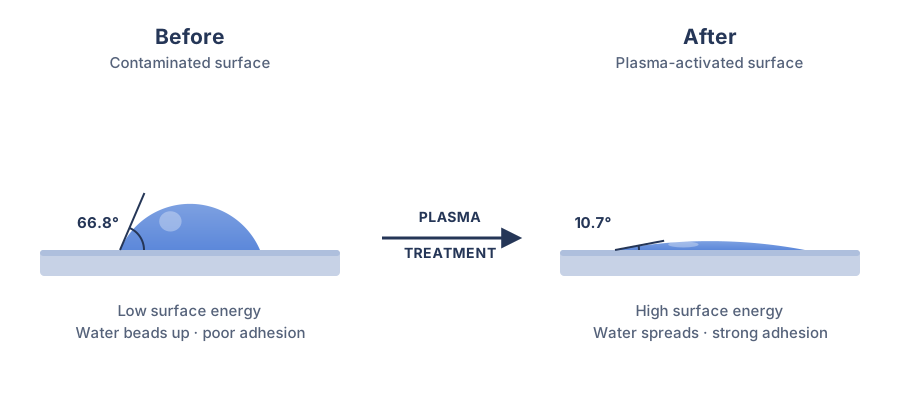
Contact-angle measurement before and after treatment is the fastest wettability check on the line, tracking the same surface-energy shift that drives both paint adhesion and composite bonding. Given the structural consequences of a bad bond in this industry, that screening check has to be backed by correlation against bond-strength and peel-test results on composite and metal assemblies, not treated as sufficient on its own — a plasma step that looks right on a contact-angle reading but hasn't been validated against real bond-strength data is exactly the kind of gap that turns into a structural finding later.
Recommended systems
Related applications
Related articles

Plasma Cleaning in the Aerospace Industry
Improve aerospace industry standards with plasma cleaning. Explore its crucial role in aerospace component maintenance.
Metal Surface Treatment: Techniques and Benefits
Metal surface treatments are crucial in the lifecycle of metal products, enhancing their durability, appearance, and functionality. ...

Plasma Cleaning of Silver, Copper, and Other Metals: Techniques and Applications
Explore the latest advancements in plasma cleaning of metals like silver and copper. Enhance efficiency and application versatility.
Frequently asked questions
Why does aerospace-grade titanium need more aggressive oxide removal than general metalworking?
Aerospace stock, after machining and storage, can carry oxide layers thicker than a surface film — removing oxide at that thickness needs more plasma energy and longer dwell time than a standard monolayer-cleaning cycle.
How does plasma treatment improve CFRP composite bonding?
Oxygen plasma activates the carbon-fibre surface, raising its surface energy so resin wets and bonds to the fibre properly — an under-activated fibre surface is a delamination risk built into the joint before it's ever loaded.
Can plasma cleaning damage sensitive components like MEMS gyroscopes or optical sensors?
Only if the process isn't tuned for it. Lower-power, tightly controlled recipes are used specifically for these components, removing contamination without damaging the delicate structures that give the sensor its precision.
Which system fits aerospace processing — Aeon-HP or Juno?
Aeon-HP brings sustained high-power capability to a table-top footprint, for the higher energy and longer dwell times aerospace surfaces often need; Juno's reconfigurable shelves take bulky or awkwardly shaped parts that don't share a common footprint, treating them together in one batch.
How do we verify a plasma step given the structural consequences of a bad aerospace bond?
Contact-angle measurement is the fast screening check, but it has to be backed by correlation against bond-strength and peel-test results on real assemblies — a contact-angle pass alone doesn't validate structural bond performance.