

In medical device manufacturing, poor surface preparation can lead to weak adhesive bonds, inconsistent coating adhesion, and costly production rejects. Even when components appear clean, their surface properties may prevent adhesives and coatings from bonding as intended.
Vacuum plasma treatment offers a way to address these challenges by cleaning and modifying material surfaces before critical manufacturing steps. However, achieving consistent results depends on selecting the right treatment for the material and application.
This article explores how vacuum plasma treatment supports medical device manufacturing, where it can make a difference, and what manufacturers should consider when integrating it into their production processes.
Why Medical Device Surfaces Are Difficult to Bond and Coat
Many materials used in medical devices, including polyethylene (PE), polypropylene (PP), polyether ether ketone (PEEK), and silicone, have surface properties that make adhesion difficult. Their relatively low surface energy or chemical inertness can prevent adhesives and coatings from spreading evenly and forming reliable bonds.
The challenge becomes greater when manufacturing residues, oils, or mold-release agents remain on the surface. These contaminants can interfere with adhesion, even when a component looks perfectly clean.
Surface energy plays an important role here because it influences how readily a liquid spreads across a material, a property known as wettability. Poor wettability can contribute to inconsistent coating coverage and weak adhesive bonds.
For manufacturers, this means visual cleanliness alone is not enough. The surface must also be properly prepared for the next production step.
How Vacuum Plasma Treatment Prepares Medical Device Surfaces
Vacuum plasma treatment addresses surface preparation challenges by cleaning and modifying the outermost layer of a material without significantly altering its bulk properties when properly controlled.
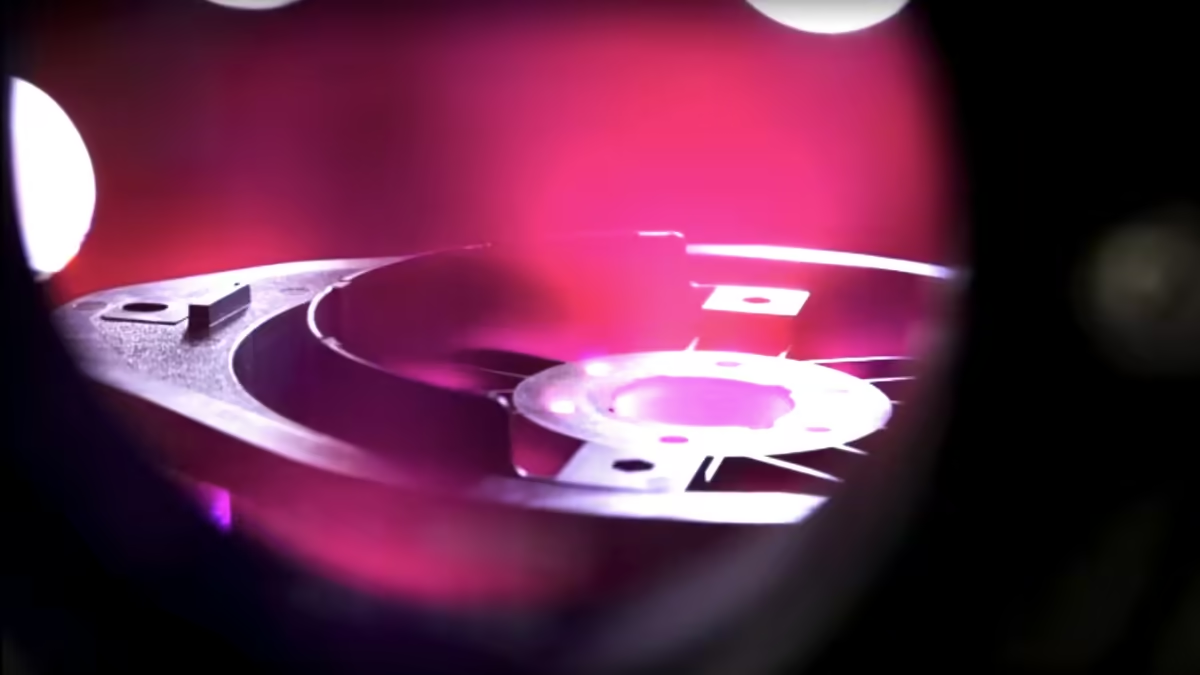
The process takes place inside a low-pressure chamber, where gases such as oxygen or argon are energized to create plasma. Depending on the material and the required outcome, the treatment can perform several functions:
- Surface cleaning: Removes suitable organic contaminants, including oils and manufacturing residues, that may interfere with adhesion.
- Surface activation: Modifies surface chemistry to improve wettability, helping adhesives and coatings spread more evenly and form stronger bonds.
- Controlled etching: Modifies surface topography to support adhesion where additional surface texture is beneficial.
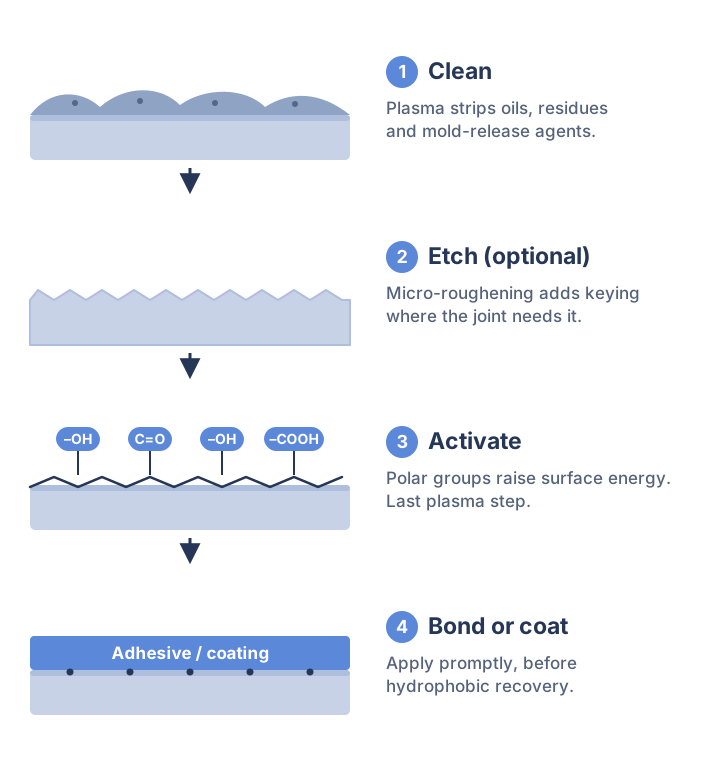
The choice of process gas and treatment parameters depends on the material, contaminants, and intended application.
It is important to note that, while vacuum plasma treatment can improve surface cleanliness, it does not replace validated sterilization processes required for medical devices.
Applications of Plasma Treatment in Medical Device Manufacturing
Different medical devices present different surface preparation challenges. Vacuum plasma treatment can be adapted to address these requirements, whether manufacturers need better coating adhesion, stronger adhesive bonds, or more consistent surface properties.
Preparing Catheters for Coating and Bonding
Catheters often require hydrophilic or lubricious coatings to reduce friction during use. However, poor surface wettability can make it difficult for these coatings to adhere consistently.
Plasma pretreatment modifies the catheter surface to improve coating wettability and adhesion, helping manufacturers achieve more consistent coating performance.
Surface Activation of PEEK and Implant Components
PEEK is valued for its strength, chemical resistance, and biocompatibility in suitable medical applications. However, its chemical inertness can make bonding and coating difficult.
Vacuum plasma activation modifies the surface chemistry of PEEK and other compatible implant materials, preparing them for subsequent coating or adhesive bonding without necessarily changing their underlying mechanical properties.
Improving Adhesion in Medical Device Assemblies
Connectors, tubing, and multi-component housings often rely on adhesive bonds to maintain assembly integrity. When surfaces have poor wettability or residual manufacturing contamination, these bonds may be unreliable.
Plasma cleaning and activation help prepare bonding surfaces, supporting stronger and more consistent adhesion between compatible components.
Preparing Diagnostic and Microfluidic Components
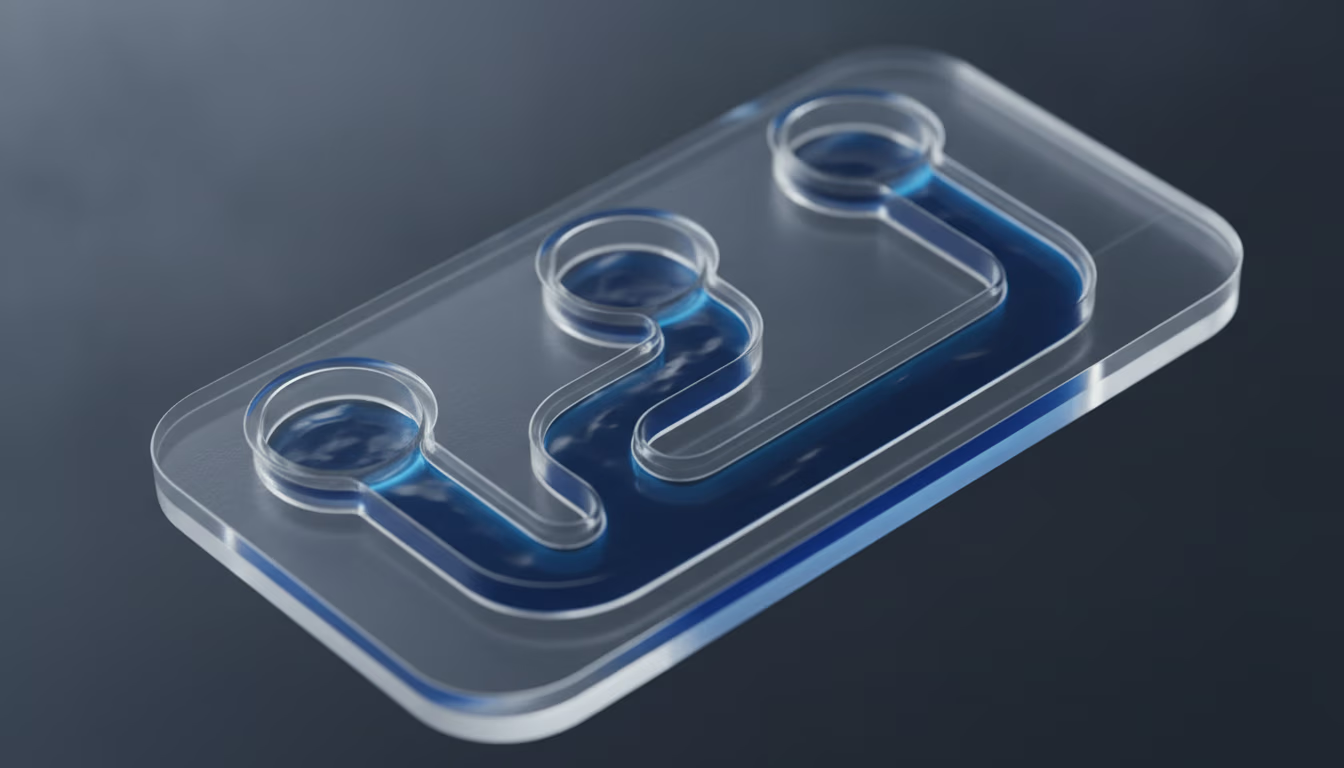
Microfluidic devices and diagnostic components often contain small channels and delicate surfaces that require controlled preparation before bonding or coating.
Vacuum plasma treatment can improve surface wettability and prepare compatible materials for subsequent processing. Treatment conditions and component geometry must be evaluated to ensure the required surfaces are adequately treated.
Common Plasma Treatment Challenges and How to Address Them
Even after plasma treatment, manufacturers may experience poor coating adhesion or inconsistent bonding results. This doesn't necessarily mean the treatment is ineffective. Several factors can influence how well a treated surface performs during subsequent manufacturing steps.
Some common challenges include:
- Hydrophobic recovery: Certain polymers gradually lose their improved wettability after plasma activation. Minimizing the time between treatment and bonding or coating can help preserve the intended surface properties.
- Surface recontamination: Handling, packaging materials, or migrating additives can introduce contaminants after treatment. Controlled handling and storage practices help protect the prepared surface.
- Inconsistent plasma exposure: Complex geometries or unsuitable fixturing may prevent certain areas from receiving adequate treatment. Reviewing component positioning, chamber loading, and process settings can improve consistency.
- Overtreatment: Excessive plasma exposure can damage sensitive surfaces or negatively affect adhesion. Adjusting power, treatment time, and other process parameters helps avoid unwanted surface changes.
Addressing these challenges requires more than simply increasing treatment intensity. Manufacturers need a process tailored to their materials, component geometry, and subsequent production requirements.
Validating Plasma Treatment for Medical Device Production
Achieving good results during initial testing is important, but medical device manufacturers also need confidence that those results can be reproduced consistently throughout production.
Validation typically involves assessing both the treated surface and its performance in subsequent manufacturing steps. Common methods include:
- Contact-angle testing: Measures surface wettability to help assess whether plasma activation has achieved the intended effect.
- Adhesion testing: Uses methods such as peel or pull testing, where appropriate, to evaluate the strength of bonds or coatings.
- Process monitoring: Tracks parameters such as gas flow, chamber pressure, power, and treatment time to help maintain consistent processing conditions.
- Production records: Document treatment settings and results to support traceability and quality control.

These activities can form part of equipment qualification and process validation within an ISO 13485-aligned quality management system.
Ultimately, successful validation means demonstrating that controlled plasma treatment consistently supports the required downstream performance, not simply achieving a favorable surface measurement.
Choosing Vacuum Plasma Equipment for Medical Devices
Selecting the right vacuum plasma equipment depends on more than the treatment itself. Manufacturers need a system that accommodates their components while delivering consistent results within their production environment.
Important considerations include component size and geometry, material sensitivity, production volume, and how the equipment will integrate with existing manufacturing processes.
Vacuum or Atmospheric Plasma?
Plasma surface treatment is also available at atmospheric pressure, usually as a nozzle or jet that passes over the part. The two suit different jobs:
| Vacuum plasma | Atmospheric plasma | |
|---|---|---|
| Where it runs | Sealed low-pressure chamber | Open air, at the part, from a nozzle or jet |
| Surfaces treated | All exposed surfaces of every part in the load, including complex 3D shapes | The area passing under the nozzle (line of sight) |
| Process gas | Selected gases such as oxygen, argon or mixtures, at controlled flow and pressure | Mostly compressed air or nitrogen |
| Production style | Batch or automated inline cycles | Continuous, integrated into a moving line or robot cell |
| Typical medical use | Whole-part cleaning and activation of catheters, implants, connectors and diagnostic components | Local treatment of a bond line or seal area on larger assemblies |
For a closer comparison, see our guide to atmospheric plasma treatment.
SCI Plasma Systems for Medical Device Manufacturing
SCI Plasma offers several solutions to meet different processing requirements:
- Aeon: A compact, tabletop batch plasma system suited to laboratory applications, process development, and smaller production runs.
- Juno: A flexible batch system with adjustable shelving and gas distribution designed to accommodate irregularly shaped components and complex geometries.
- Custom plasma systems: Tailored solutions for manufacturers with specific component handling, processing, or production integration requirements.
For higher-volume manufacturing, SCI Plasma also offers inline plasma systems that can be integrated into automated production workflows.
Before selecting equipment, manufacturers should test representative components under realistic processing conditions. This helps establish suitable treatment parameters, assess material compatibility, and determine whether the system can meet production and quality requirements.
Improve Medical Device Surface Preparation With SCI Plasma
Reliable surface preparation starts with understanding the material, the manufacturing challenge, and the performance requirements of the finished device.
With experience in vacuum plasma cleaning, etching, and surface activation equipment, SCI Plasma provides standard and customized solutions to support demanding manufacturing applications.
Whether you're addressing coating adhesion problems or introducing plasma treatment into your production process, contact SCI Plasma to discuss your requirements and explore a suitable solution.